

 Insights.
What is website search engine optimization (SEO) and what activities does it involve
05 Jul, 2017
Marketing
Website optimization for Google and other search engines involves various on-page and off-page activities aimed at improving a website's search engine rankings. Most people don't look past the first page of Google search results. So, it's a big advantage if your website shows up on the first page for keywords related to your business. The higher your website is on Google's search results page, the more people will click on it. This means more visitors to your website, who might become customers.
Website optimization consists of two main categories:
- On-site SEO
- Off-site SEO
On-site SEOOn-site SEO includes activities that are done on the website itself to improve its position. Here are some of the main segments of on-site optimization that you must pay attention to if you want to rank on Google.
Title tag
The title tag is a key part of on-site optimization, and it is essential that your keyword for which you want to rank on Google appears in the title. The title you enter in the title tag will appear on the Google results page, on social networks, and in the browser tab. It plays a critical role in determining whether a reader will click on your website or not. If the title is uninteresting or incomprehensible and does not grab attention, there is a small chance that someone will decide to click on that link.
The title is the most important thing in content marketing because it depends on how many readers your content will attract. Typically, Google displays the first 50-60 characters of your title tag. To see how your title will appear on Google, click this link.
Here are a few things to keep in mind when writing your headline:
- Do not exceed the title length of 60 characters
- Every page on your web should have a unique title
- Put important keywords at the beginning of the title
- Don't overdo it with keywords – make the title sound natural
Meta description
A meta description is a concise summary of a webpage. It is important because it is displayed as a description on search engine results pages, social networks, and more. The meta description can be of any length, but search engines generally shorten summaries to longer than 160 characters.
Although the meta description does not directly impact a page's search engine rankings, it is still crucial. A well-written, intriguing, and attention-grabbing meta description can entice more people to click on your website and visit it. When writing a meta description, make sure that it is interesting, useful and that its length does not exceed 160 characters.
Keyword research
In order to even rank on Google, you need to target some keywords that your potential customers are searching for on search engines. To find out what keywords your potential customers are searching for, you can use Google's Keyword Planner. To use the tool, enter relevant keywords related to your business. The tool will then suggest additional keywords and provide data on the average number of monthly searches for each phrase.
Integrating keywords into the page
In the past, people could improve their ranking on Google by using the same keyword many times in their text. It didn't matter if the keyword was in a strange or illogical place. But today Google is more sophisticated and such things don't happen anymore. If you don't want Google to remove your website from search results, follow their rules. Use keywords in your text, but don't overdo it.
The keyword should be in the title of the article and should appear naturally a few more times in the text. The images in the article should have an alt tag with a keyword, which will contribute to the ranking on Google Images.
Add long-tail keywords to your content as they are easier to rank for and should complement your primary keywords.
To clarify what long-tail keywords are:
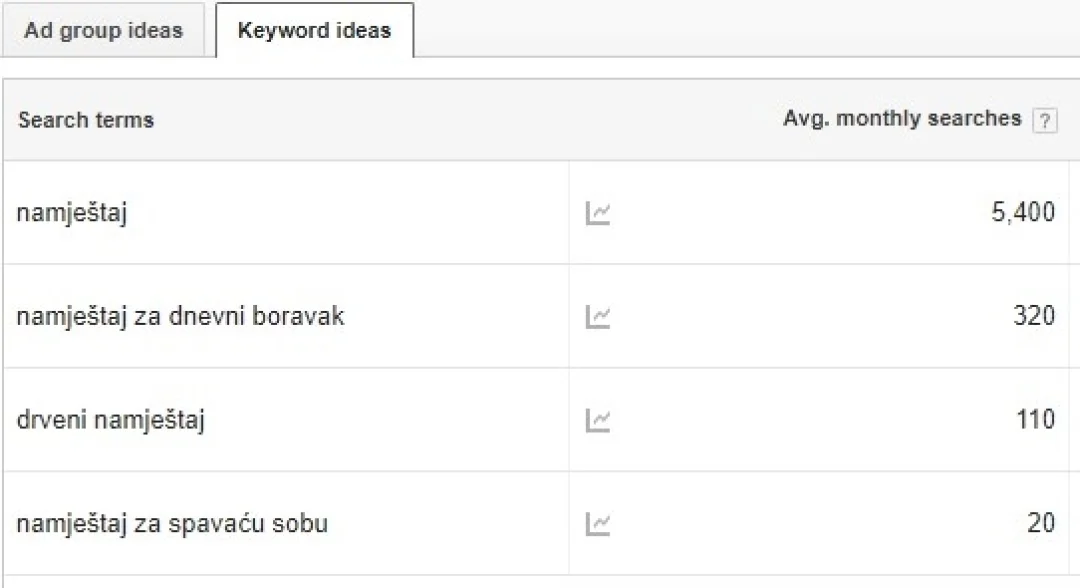
For example, the primary keyword could be "furniture." However, this keyword is too general and it would be impossible to rank for it on Google without a large budget and several months of work. That's why long-tail keywords are used, which are more specific and easier to rank for. Examples of long-tail keywords are "bedroom furniture", "wooden furniture", "living room furniture", etc.

Use links to other people's and your own content
Google likes it when you include a link(s) in your article to various sources or places where readers can read more. It is recommended to have at least one link to an external source, but when you link, make sure that the content to which the link goes creates additional value for the reader, that you do not link to anything just for the sake of the link. Also be sure to integrate a link to another page on your web if you have content that is related.
Improving website speed
The speed of a website mainly depends on the way it is made. But there are often some other items that can be improved to make the site faster.
You can check your website speed with free online tools like Pingdom.com and Gtmetrix.com.
Improving the speed of a website requires more advanced technical knowledge, and for this it is best to hire an expert or, if your website is already outdated, create a new website with new technology
SEO-friendly URL
It is used to make the links as readable as possible for users, and to make it easier for search engines to access the content of your page.
For example, http://bid.hr/google-adwords/
is much better than http://bid.hr/hjsliirh24/
Creating descriptive categories and document titles on your website will help keep your site better organized and will also help your documents rank. In addition to all that, it can create simpler, so-called friendly URLs for users who want to link to your content. Visitors can sometimes be intimidated by extremely long and mysterious URLs that contain unrecognizable words or characters.
Canonical tag to prevent duplicate content
The canonical tag is an HTML element that helps webmasters prevent content duplication issues. It prevents Google from penalizing a website for having duplicate content. Google frowns upon identical content across multiple pages. For instance, if you intend to publish your web content on platforms like Medium, you must use the canonical tag. This informs Google that the content is not duplicate and addresses the original source.
If you have several similar versions of the same content on your website, choose one "canonical" version and direct search engines to it. This solves the problem of duplicate content in which search engines do not know which version of the content they should display.
Regular publication of content
Google likes websites that release new content regularly, so a blog will help you rank a lot. Publishing new and valuable content regularly has several benefits. Firstly, it provides Google with fresh content, giving you an edge in its rankings. Secondly, having more content increases the likelihood of your website being discovered on Google. In addition to helping search engines find your website, a blog is a good way to talk to your customers, both current and potential. You can use it to show that you know a lot about your business and to build trust.
When writing content, it is important that you do not copy other people's content and that you publish only original text. Besides copying someone else's content would be a copyright violation, Google would also penalize you for duplicating content.
Off-site SEO
SEO changes drastically from year to year. What worked great just a few years ago is now the ideal recipe for getting a penalty from Google. Buying many low-quality links or creating a private website network (PBN) to direct to your site is ineffective. Today, quality comes first, and instant results that used to be possible with all kinds of techniques are no longer possible today. If you want to get to the 1st page of Google, and especially the 1st position, you have to play by the rules and put a lot of work into it.
Off-site SEO is a set of activities that, as the name suggests, are performed outside of your website. Off-site SEO involves building links that come from other websites to yours.
Links from other sites are one of the most important criteria for website ranking. A website with more quality links will have an advantage in the eyes of Google.
But not every link is equal. For off-site SEO to be effective, it is essential to obtain backlinks from high-quality websites—those that Google considers authoritative.
Websites Google likes are:
- High authority domain and site website that you can check here
- Popular websites
- Websites that are related to the topic you are writing about
- Websites with 'fresh' content
You can get links on websites in several ways:
- Naturally - i.e., someone likes your content and links to yours from their website
- On your own initiative - this includes publishing so-called guest posts on other people's pages, i.e. you write a post for someone else's website and in return you get a link to your website. It is also possible to pay for links, but this is not recommended. Links from such websites are often worthless or even prohibited by Google, and sometimes can even cause more harm than good.
Create content worth linking to
In order to get links from quality websites as easily as possible, it is necessary to regularly publish content that websites can link to. If your business website only has "About Us", "Products", "Contact" and "Home" pages, other websites and blogs will have no reason to include a link to your website. But if you have articles on your blog that inform and help readers, more websites will have a reason to link to your website, i.e. some of your articles.
Including interesting articles that can be shared on social media will help you reach more people and potential customers who are active on those platforms.
Conclusion
This text briefly introduced you to SEO optimization and activities that are necessary to rank on search engines. This map provides beginners with a basic understanding of which direction to go in optimizing a website. However, to truly optimize a website professionally, extensive knowledge and practice are necessary. So start reading on the Internet, familiarize yourself with the subject. Read our articles on the topic of optimization, and if you would still prefer to leave it to the professionals, feel free to contact us.
For more information, read: