

 Insights.
News from the world of Google Ads advertising
11 Nov, 2021
Marketing
News from the world of Google Ads advertising
Digital marketing is constantly evolving, so professionals in this field must consistently stay updated on the weekly changes that occur. It's important for people in charge of digital marketing to keep an eye on the latest trends and news. This applies to people who manage digital marketing in their company and those who have hired people or agencies to do those tasks.
It's important to keep learning and testing the advertising tools available. This way, you'll find out what works and what doesn't. Each company has its own characteristics and its own audience, so the methods of promotion cannot be identical for two companies. That is why an individual approach and regular testing are extremely important. In this article, we will highlight the latest developments in the realm of Google Ads. We have compiled a comprehensive list of noteworthy updates that have either recently occurred or are currently underway.
Removal of expanded text ads
From June 2022, it will no longer be possible to create new ETA ads (Expanded text ads). ETA ads were very well received by advertisers, and we can even say beloved. From June 2022, only Responsive search ads (RSA) will be available. ETA ads will still be shown, but they will no longer be editable, only paused or permanently removed.
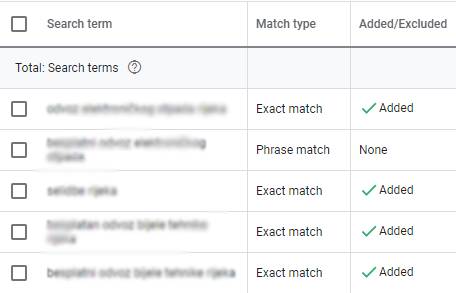
Data added to the search terms report
In response to numerous complaints from advertisers, Google has recently reintroduced additional data to the search terms report. This data had previously been limited since 2020.
End of Gmail ads
From July 2021, you can no longer create new Gmail campaigns or modify existing ones.

Source: https://www.wordstream.com/blog/ws/2021/02/16/gmail-ads-going-away
Changes related to keywords
Phrase match expansion in February 2021.
In February 2021, Google released a phrase match extension to cover all additional traffic generated through broad match with the modifier. How did they decide to expand the phrase match? So that phrase match expansion includes additional broad match modifier traffic.
Cancellation of broad match modified (Broad match modified)
In July 2021, broad match with the modifier was completely phased out. Consequently, you should no longer create new keywords with the broad match modifier.
With Google's update, reaching the appropriate customers through search will become simpler. However, the update will maintain the significance of word order when it affects the intended meaning. Advertisers will be given greater control and correspondingly better reach.
Google reduces visibility in the Search Terms Report
In September 2020, Google restricted the reporting of search terms within Google Ads. Only those terms that reach a certain search volume are now displayed.
Abolition of the Average Position metric
Average Position is a metric that shows the average position of your ad. If your ad mostly revolves around position 1, the metric shows a number close to one. For instance, if your ad rotates between position 1 and position 10 equally, the average position metric will show around 5, which can be misleading.
This metric will be discontinued in September 2019. Instead of the average position, several metrics in the Google Ads interface can provide more useful information about the ad's position. These metrics include:
- Impressions (Absolute Top) %: Percentage of ad impressions that were displayed in the 1st position
- Impression (Top) %: Percentage of ad impressions that were near the top, in position 1 to 4
- The average position metric was useful, but the above two metrics are good alternatives.
Expanded Call-Only Ad Text
Expanded ads always make us happy, and so is the additional extension for ads that serve to attract callers.
One major drawback of Call-Only ads was the lack of space for text. This change gave us the option to include two headlines in the ad, and 90 characters in the ad description. This change will bring better results for advertisers as the ads will now contain more information that can interest potential customers or clients.
Optimization Score - recommendations for improving campaigns
One useful option has been added to the "Recommendations" section of the Google Ads interface. The optimization score tells us how optimized the account is on a scale from 1 to 100. Because this is an automated option, it can't always accurately assess the quality of an advertising account. Therefore, it shouldn't be blindly trusted. However, it can often be useful for generating new ideas to optimize an account.
This feature comprehensively evaluates your advertisements, extensions, bids, and tactics, and provides recommendations for improvement. It also highlights the various options at your disposal and advises on how to effectively leverage them.
Display ads - pay for conversions instead of clicks
While previously we could only pay for ad clicks on the Display network, the option of paying for conversions has now been introduced. In this way, it is easier to maximize the return on investment.
With this bidding method, you will only incur costs when a conversion is achieved on your website. This may include actions such as downloading an application, submitting an inquiry via a form, or making a purchase in your online store.
Video ads got new "call-to-action" extensions
In today's marketing landscape, video advertising has gained significant traction, with an increasing number of businesses incorporating it into their promotional strategies. As such, it comes as no surprise that Google is continuously striving to enhance and introduce innovative features for video advertising. One of the useful options is the introduction of a new Call-to-action extension.
In the past, viewers had to watch an entire video before the call-to-action (CTA) button appeared. Now, the CTA button is present throughout the duration of the video ad. With this option, potential customers or clients don't have to wait until the end of the video. Instead, they can click on the CTA button at any time and be directed to your website.
With all these changes that regularly occur in digital marketing, feel free to contact us for assistance with Google Ads advertising.
You can read even more information about Google Ads changes at the following sources: