

 Insights.
5 tips how you can immediately improve your AdWords campaigns
08 May, 2017
Marketing
AdWords is a great, complex tool that can bring you many new customers. But at the same time, AdWords is a great, complex tool that can cost you a lot of money for no profit. It all depends on how you use it. Of course, the more experience you have in setting up campaigns, testing ads, and targeting locations, the better your campaigns will be. This means you're less likely to waste money and more likely to see a significant return on investment.
If you're unhappy with your AdWords campaign results or want a better return on investment, consider our campaign improvement suggestions.
Our tips will help you:
- Identify areas for improvement
- Boost your campaign performance
- Get a higher return on investment
In this text, we bring you five useful tips for improving your AdWords campaigns that you can implement immediately.
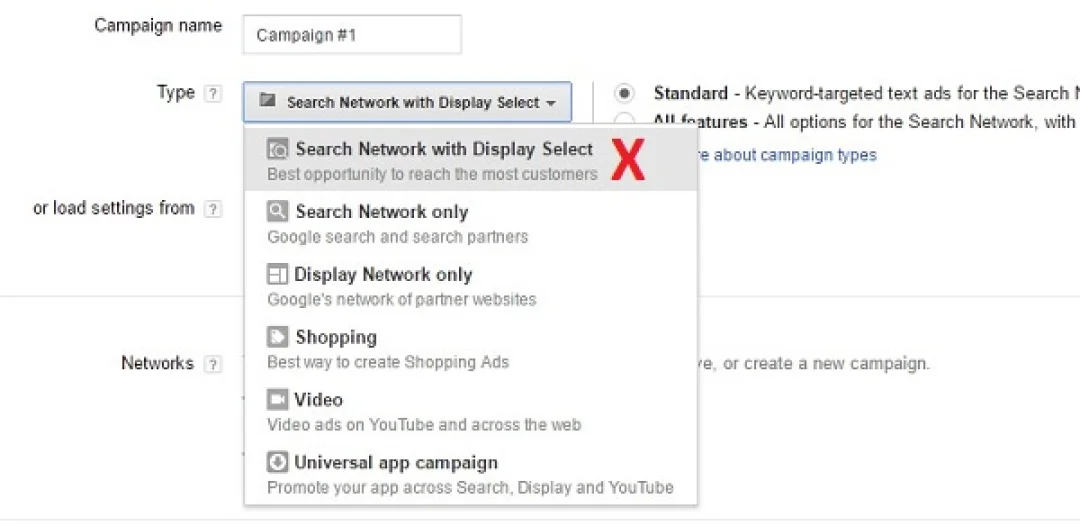
1. Never use the search & display network together
When you create a new campaign, one of the first things you can choose is the campaign type. There you are offered a search campaign, a display campaign, a search & display campaign, etc... Using the search & display option is most often a waste of money. Mixing search and display ads in one campaign makes it harder to analyze their performance and profitability separately.
Combining two different campaign types and displaying shared metrics can make it challenging to analyze critical metrics. These include click-through rate, average positions, conversion rate, and more.
Additionally, in this case, display ads are presented to you in text format. Text ads generally don't bring nearly as good results as when you separate the display campaign and create high-quality image ads.
Always separate search campaigns from display campaigns. This allows you to easily track each advertising channel and modify and optimize each for the best return on investment.
2. Test and improve
Don't think you're done forever once you set up your campaigns. Now comes constant optimization, testing, and modifications to make sure you get the best possible return on investment.
Always create a minimum of 2 ads for each ad group and modify over time depending on which ad brings better results. To optimize your advertising campaign, track key metrics such as click-through rate (the percentage of people who click on an ad) and conversion rate. Based on these metrics, make the necessary adjustments to existing ads or create new ones.
3. Structure keywords wisely
Keywords should be structured so that you have control over all ads - when they appear and when they don't. Using broad keywords (keywords that will appear whenever your default keyword appears, or in any variation of it) won't be effective. For example, your ad for "cooking class" will appear when someone searches for "cooking pot cooking," which will waste your money.
It is recommended to create separate ad groups for each version of the keywords, such as exact match, phrase match, and broad modifier match. This enables precise control over the display of ads and their consumption, providing that nothing is left to chance.
It's also extremely important to implement negative keywords so that your ads don't appear for completely irrelevant terms. To see if your ads are appearing for irrelevant search terms, periodically, check the "Search terms" report under the "Dimensions" tab in your campaign. There you will see the terms that people searched for on Google when they saw your ad. If you notice that your ad is appearing for useless terms that have nothing to do with your offer, include them in your negative keywords
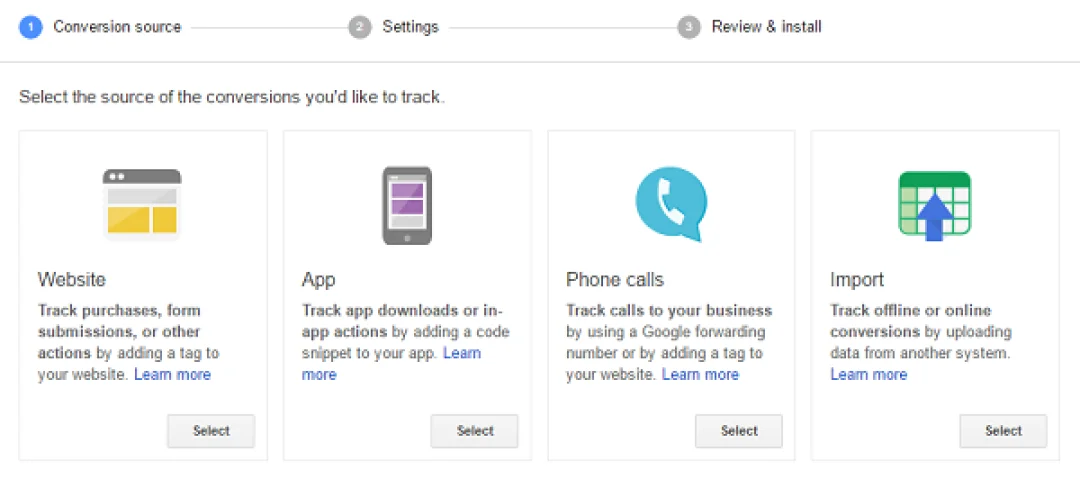
4. Track conversions and return on investment
If you have something on your website that you can track to get a rough estimate of conversions, you should definitely do it. Visitors can book accommodation through a booking system. They can send inquiries about your service using a contact form. They can also download a demo version of your product to their computer.
By tracking conversions, you can improve your campaigns because you'll know which ads and keywords bring you the most profit. Based on this data, you will be able to redirect your budget to those campaigns that bring you the best results.
5. Make the ads as relevant as possible
If a potential customer searches for "cooking class" on Google, it would be good if the ad also uses those exact words, in that order. If he searches for "Cooking education", the ad will do better if it contains those exact words, in that order.
To easily implement the exact keywords potential customers are searching for on Google, type {keyword: replacement text} inside the ad instead of the keyword. Under "substitute text" enter the term that will appear if the ad can't replicate the term the user was searching for.
- If you want the first keyword to start with a capital letter, for example, "Cooking class", type: {Keyword: Alternative text}
- If you want all keywords to be added to the ad to start with a capital letter, for example, "Cooking Course", enter: {KeyWord: Alternative Text}
- If you want all letters in keywords to be written in lowercase, for example "cooking course" use {keyword: replace text}
Conclusion
Let's focus on implementing these five practical tips to enhance your AdWords campaigns, rather than discussing potential improvements indefinitely. These tips will significantly benefit your campaigns.
In case you are not sure how exactly Google AdWords works, read this article first.
If you still want to leave AdWords advertising in the hands of our experienced AdWords specialists, we are here for you.
Read more:
http://www.conversioner.com/ppc-optimization/19-powerful-tips-google-adwords-campaign-optimization